
Thermal oil boilers for industry: where they are used and how to choose one
Industrial plants often need stable heating of equipment, raw materials and process units to high temperatures. Such duties are handled by thermal oil boilers: industrial equipment that transfers heat by means of a special liquid heat transfer fluid.
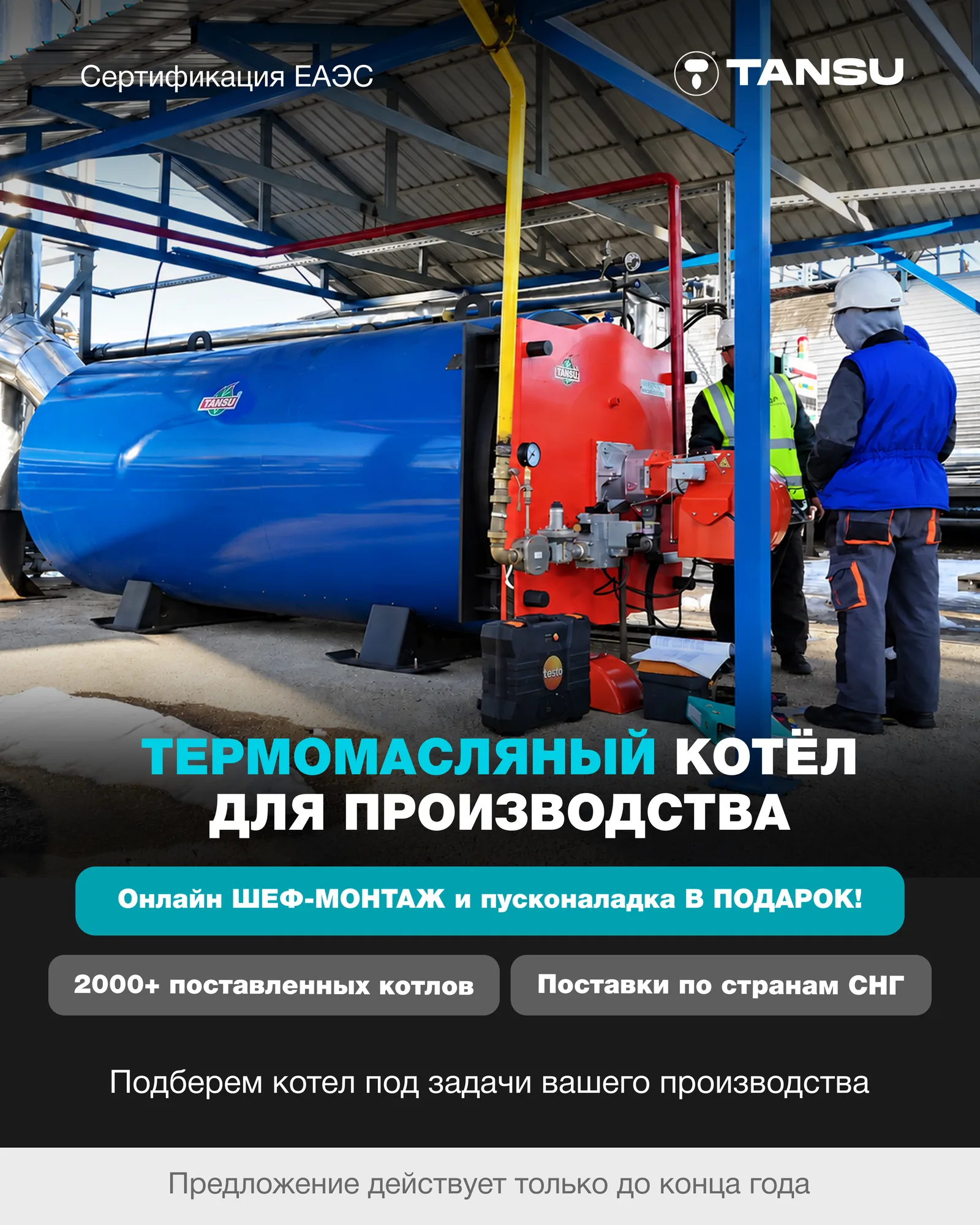
A thermal oil boiler makes it possible to set up high-temperature heating without using high-pressure steam. Such systems are in demand in the petrochemical, food, woodworking and other industries.
Let us examine how a thermal oil boiler works, where it is used and what to look for when choosing equipment for a plant.
What a thermal oil boiler is and how it works
A thermal oil boiler is an industrial heater designed to heat a special thermal oil. Once heated, the heat transfer fluid circulates through the pipework and delivers thermal energy to the production equipment.
Main components of a thermal oil system:
- a boiler with a spiral coil;
- a burner unit;
- circulation pumps;
- an expansion tank;
- a degasser;
- a temperature control and monitoring system.
This design makes it possible to set up stable circulation of the heat transfer fluid and to maintain the required temperature conditions in production processes.
Where industrial thermal oil boilers are used
Industrial thermal oil boilers are used at plants that need controlled heating of equipment and materials.
Main applications:
- Oil refining and petrochemicals: heating petroleum products, tanks and process units.
- Bitumen and asphalt production: maintaining the required bitumen temperature and heating production equipment.
- Woodworking: supplying heat to hot presses in the production of particle board and other wood-based panels.
- Food industry: heating process vessels, oils and production units.
- Chemical industry: maintaining the temperature conditions of reactors and process equipment.
- Paper and board industry: supplying heat to certain drying and production processes.
Advantages of a thermal oil heating system
Thermal oil heating suits processes that require the liquid heat transfer fluid to be at a high temperature.
Main advantages:
- High heating temperature: high temperatures can be reached without resorting to high-pressure steam.
- Even heat transfer: the circulation of the oil delivers thermal energy to several consumers.
- Temperature control: the control system helps to maintain the required parameters.
- Flexibility of use: the equipment can be integrated into various production lines.
The choice of such a system depends on the plant’s process requirements and the specifics of the production process.
How a thermal oil boiler differs from a steam boiler
The main difference lies in the heat transfer medium used. In a thermal oil system heat is transferred by liquid oil, and in a steam boiler by steam.
A thermal oil boiler is worth considering for high-temperature heating processes. If the plant needs process steam, the appropriate steam equipment should be chosen.
For more on steam supply solutions, see the TANSU industrial steam boilers page.
For plants considering coal as a fuel, solid-fuel steam boilers are also available.
How to choose a thermal oil boiler for a plant
Before purchasing an industrial boiler, several parameters need to be assessed:
- Heat output: determined by the needs of the production equipment.
- Operating temperature: depends on the specifics of the process.
- Fuel type: the availability of gas or liquid fuel needs to be taken into account.
- Heat transfer fluid circulation: the oil flow rate and the pump characteristics are calculated.
- Scope of supply and automation: the control, monitoring and safety systems are taken into account.
Selecting the right thermal oil boiler helps to ensure stable operation of the equipment and to avoid unjustified spending on industrial heating.
TANSU thermal oil boilers: specifications and capabilities
TANSU offers industrial thermal oil boilers for plants that need high-temperature heating.
Main specifications of the equipment:
- heat output: from 500 to 3,000 kW;
- operating temperature: up to 300 °C;
- working pressure: 0.5 MPa;
- fuel: gaseous and light liquid fuel;
- design: three-pass, with a spiral coil.
The range includes boilers with outputs of 500, 1,000, 1,500, 2,000, 2,500 and 3,000 kW.
The scope of supply may include Baltur or EcoFlam burners, circulation pumps, a control cabinet, an expansion tank and a degasser.
For more on the technical data and the scope of supply, see the TANSU thermal oil boilers page.
Conclusion
Thermal oil boilers are an effective solution for plants that need stable high-temperature heating as part of their processes.
When choosing equipment, it is important to consider the output, the operating temperature, the fuel type and the specifics of the heat transfer fluid circulation system.
TANSU offers industrial thermal oil boilers with outputs from 500 to 3,000 kW and an operating temperature of up to 300 °C.
You can explore the company’s products and capabilities on the official TANSU website.