
DE, KE and E boilers: specifications, models, designations and replacement options
DE, KE and E steam boilers have been in service at industrial plants and boiler houses for decades. So when a boiler house is modernised, people often search for equipment by the familiar designations: DE-10-14, DE-16-14, DE-25-14, KE-6.5, KE-10 and other models.
But when replacing a boiler, it is important to consider more than its model. The actual steam load, pressure, fuel, water treatment and the plant’s operating schedule may differ significantly from the original design calculations.
That is why the question “which DE boiler equivalent should we choose?” is better treated as an engineering problem.
In our previous article we covered the differences between DE, KE and E boilers and their modern alternatives. Now let us take a closer look at the designations, the popular models and the parameters that must be taken into account during modernisation.
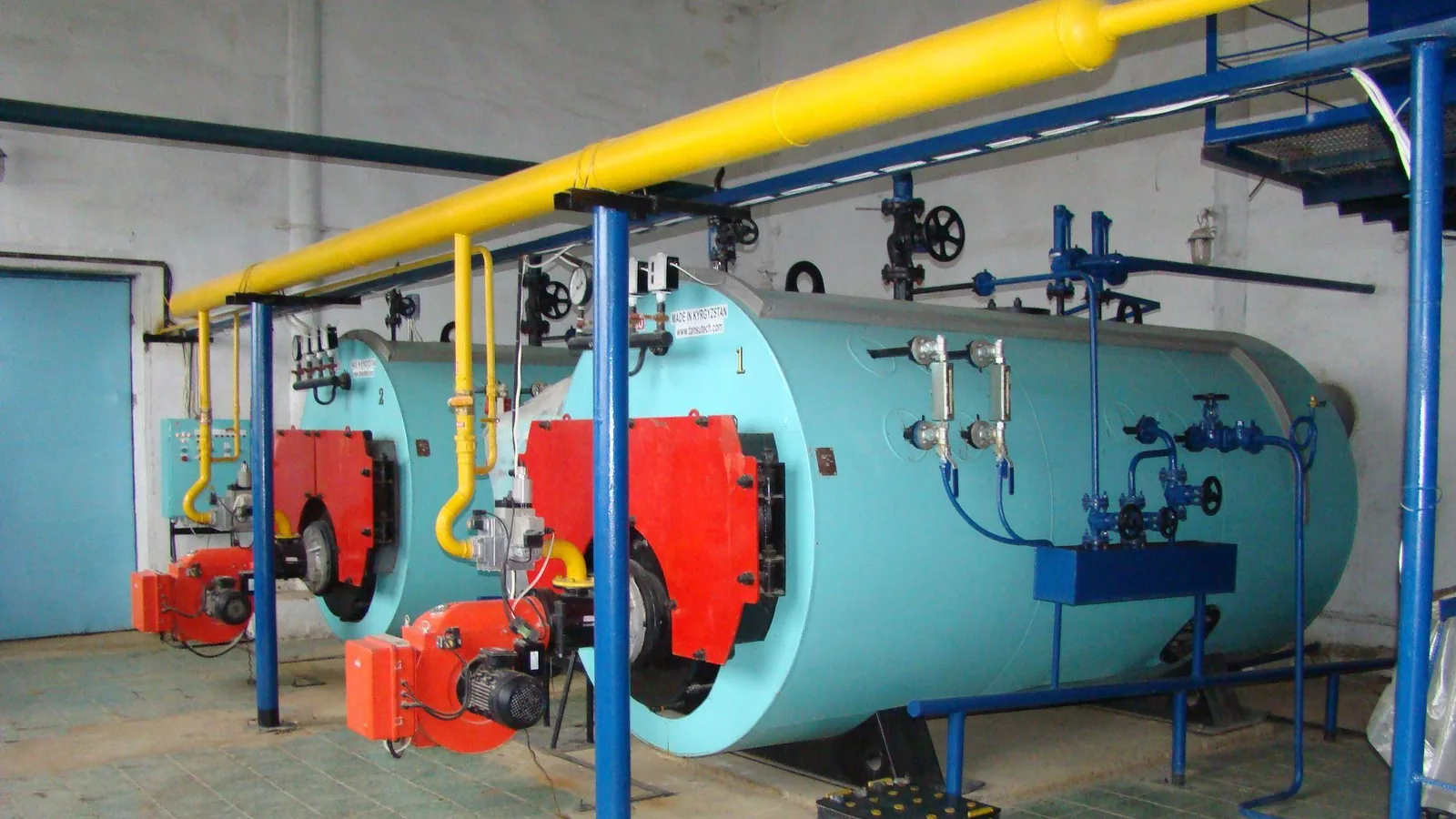
How to read a DE boiler designation
Take the designation DE-10-14:
- DE: the boiler series;
- 10: rated steam output, t/h;
- 14: rated steam pressure, kgf/cm².
So DE-10-14 denotes a boiler with an output of about 10 t/h and a rated pressure of around 14 kgf/cm².
You will also come across these models:
- DE-6.5-14;
- DE-10-14;
- DE-16-14;
- DE-25-14.
But the two numbers in the designation do not give the full picture. A DE-16-14, for example, may spend most of its time running well below its maximum output.
So in a modernisation it is important to analyse average and peak steam consumption, not just the nameplate rating.
DE boilers: the main models
The DE series came into widespread use for generating process steam and steam for power applications.
Plants run DE boilers of various outputs, including the DE-6.5, DE-10, DE-16 and DE-25.
DE-10-14
The DE-10-14 is a widely used model of industrial steam equipment.
When replacing it, you need to consider:
- actual steam consumption;
- working pressure;
- fuel type and properties;
- feedwater temperature;
- water treatment;
- burner equipment;
- the flue gas system;
- pumps and automation.
So a search for “DE-10-14 equivalent” is not enough on its own. First, the actual parameters of the boiler house have to be established.
DE-16-14 and DE-25-14: output is not the only thing that matters
Moving from a DE-10-14 to a DE-16-14 or DE-25-14 changes the load not only on the boiler but also on the boiler-house infrastructure.
You need to check:
- fuel handling;
- flues;
- feed pumps;
- water treatment;
- deaeration;
- steam pipework;
- automation;
- ventilation.
If the existing boiler runs at a low load most of the time, installing equipment of the same rated capacity will not always be the best solution.
KE boilers: what to know about the KE-6.5 and KE-10
The KE series was widely used for solid fuel. So when choosing a KE boiler, you need to analyse not only output and pressure but the entire fuel feed system.
What matters:
- the type and properties of the coal;
- moisture and ash content;
- particle size distribution;
- fuel feed;
- ash and slag removal;
- the flue duct system;
- draught;
- fuel storage.
When replacing a KE-6.5 or KE-10, for example, you have to decide which part of the existing infrastructure can be kept and what will need upgrading.
For plants that use solid fuel, TANSU manufactures a separate line of industrial coal-fired steam boilers. TANSU coal-fired steam boilers are designed for outputs of 300–2,000 kg/h and pressures up to 25 bar.
What to know about the E series
The “E” designation calls for particular care when selecting equipment. Plants run boilers of this series in a variety of configurations.
So to find an equivalent, it is best to establish the full designation and confirm:
- output;
- steam pressure;
- fuel type;
- year of manufacture;
- equipment condition;
- operating mode;
- the specifics of the existing piping.
This is especially important for older boiler houses: the equipment may have been repaired several times or partly upgraded.
How to identify an old boiler’s model
If the documentation has not survived in full, the first source of information is the manufacturer’s nameplate.
It usually shows the model, output, pressure, serial number and year of manufacture.
For a proper selection, it is also worth gathering:
- the boiler’s technical passport;
- fuel consumption data;
- actual steam output;
- working pressure and temperature;
- feedwater data;
- water-treatment parameters;
- burner or furnace specifications;
- chimney parameters;
- pump and automation data.
That way you can compare not just two boilers but two complete process systems.
The right way to look for a DE boiler equivalent
The common approach:
DE-10-14 → find a DE-10-14 equivalent.
But the sounder engineering approach is to work from the parameters:
actual load → output → pressure → fuel → operating schedule → infrastructure → a suitable boiler design.
This makes it possible to consider equipment beyond the same series.
A modern steam boiler may have a different design and still meet the requirements of a specific production process.
Can a modern boiler replace a DE, KE or E?
In a number of projects it can, provided the equipment matches the technical parameters of the site.
TANSU, for example, manufactures fire-tube steam boilers for gaseous and liquid fuels with outputs of 300–25,000 kg/h and pressures up to 25 bar. TANSU steam boilers
The design is based on a three-pass path of combustion products through fire tubes surrounded by water. That said, a TANSU is not a design copy of a DE, KE or E. It is a distinct technical solution that can be used in certain projects when a boiler house is modernised.
What to compare when replacing a DE, KE or E
| Parameter | What to check |
|---|---|
| Steam output | Average and peak load |
| Pressure | Process requirements |
| Fuel | Fuel type and properties |
| Fuel consumption | Actual and design |
| Water treatment | Capabilities of the existing system |
| Flue gas system | Whether the new boiler can be connected |
| Automation | Existing and required |
| Dimensions | Whether the new boiler fits on site |
| Service | Spare parts and technical support |
The key point: do not go by the old boiler’s nameplate rating alone.
A DE-16-14 installed several decades ago, for example, may run at a completely different load today. The plant may have expanded, scaled back or changed its process.
What TANSU offers for modernisation
When an industrial boiler is replaced, it is important to consider not only the unit itself but also its piping, burner, automation, pumping equipment and flue gas system.
For gas and liquid-fuel applications, TANSU offers equipment with outputs of 300–25,000 kg/h and pressures up to 25 bar. The declared efficiency of certain configurations reaches 92%, and with an economiser it can exceed 95%, depending on the layout and operating conditions.
TANSU also provides service support, including installation checks, commissioning and liaison with the manufacturer’s engineers.
So when looking for an equivalent to a DE-10-14, DE-16-14, DE-25-14 or KE, it is worth comparing not only the specifications but also the cost of operation, modernisation and maintenance.
The bottom line
When replacing DE, KE or E boilers, it is best not to limit the search to equipment with the same name.
The optimal sequence:
- Identify the old boiler’s model.
- Calculate the actual average and peak load.
- Determine the required pressure and steam characteristics.
- Analyse the fuel and the existing infrastructure.
- Compare several technical solutions.
- Assess not only the price of the boiler but also its long-term operation.
This is the approach that shows whether the plant needs a boiler of the same series, a modernisation of the existing system or a modern alternative design.
If your plant is planning to replace a DE, KE or E, TANSU specialists can select a solution based on the actual parameters of your boiler house: output, pressure, fuel and steam consumption pattern.